
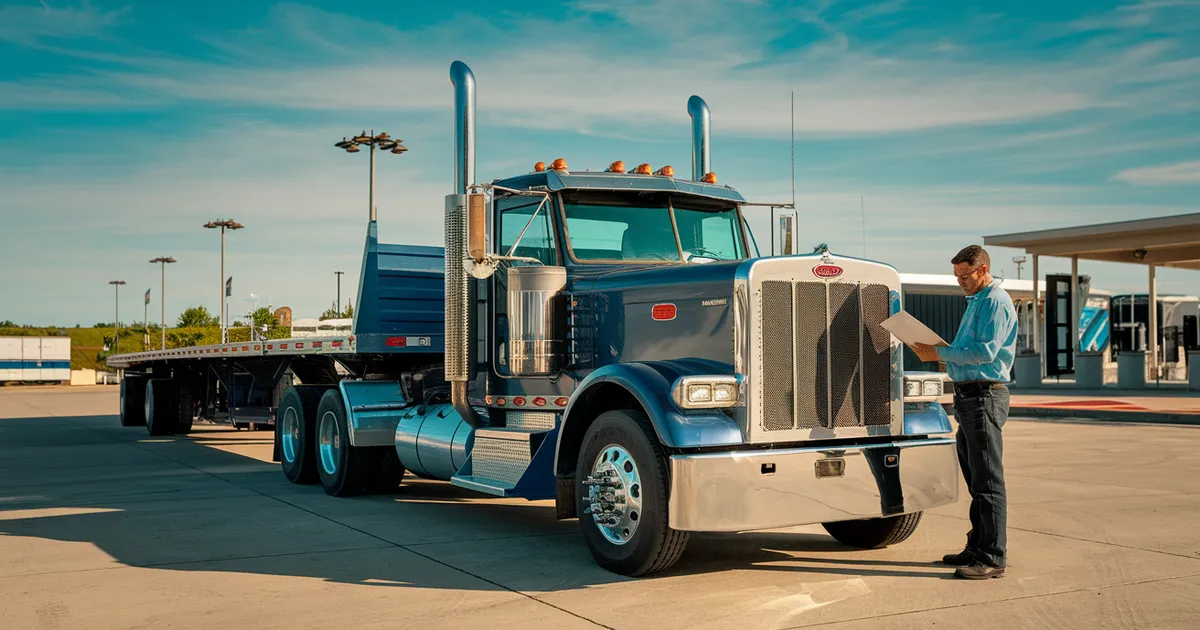
How Does Freight Factoring Work?
Freight factoring is a financing tool that converts your unpaid invoices into cash within one business day. Instead of waiting 30 to 90 days for a broker or shipper to pay, you sell the invoice to a factoring company, receive an advance of up to 95% of the invoice value, and the factoring company collects payment from your customer. MJN Services (MC#375676) has funded 26,000+ loads and works with 39,000 approved carriers in its network (as of 2026).
Below: the five steps, what it costs, and how to tell whether it fits your operation.
How Does Freight Factoring Work?
Five steps, repeated on every invoice.
Step 1: Haul the load and invoice your customer.
You complete a delivery as you normally would. Once the load is delivered, you create an invoice to the broker or shipper and gather your proof of delivery (BOL, signed delivery receipt, or rate confirmation).
Step 2: Submit the invoice to your factoring company.
Instead of mailing the invoice to your customer and waiting weeks for payment, you send the invoice and supporting documents to your factoring company. At MJN Services, invoices received by 1:00 PM MST are paid the same day. Most factoring companies accept submissions by email, fax, or through an online portal.
Step 3: Verification and advance payment.
The factoring company verifies the invoice, confirms delivery with the broker or shipper, and checks the customer’s credit. Once verified you are funded: the advance is up to 95% of the invoice, less the factoring fee, which comes out here rather than later. MJN issues your ACH the same day you submit.
Step 4: Customer pays the factoring company.
Your customer pays the factoring company directly on their normal payment terms, whether that is 30, 45, 60, or 90 days. You do not need to chase payments or handle collections.
Step 5: The reserve comes back.
The fee already came out at funding. What is left is the reserve, and once your customer pays it is released to you, less any short pays, claims or additional factoring fees. On a $2,000 invoice at a 95% advance, that reserve is $100.
One business day instead of a month. For a carrier running tight, that is the difference between fuelling the next load and sitting.
What Does Freight Factoring Cost?
Factoring fees vary by company, invoice volume, and customer payment terms. Here is what to expect.
The factoring rate is the primary cost. At MJN Services, rates start as low as 1.5%. On a $2,000 invoice that is $30. You get $1,870 at funding and the $100 reserve after your customer pays, instead of waiting 30 to 90 days on the full $2,000.
Monthly minimums apply at some factoring companies. At MJN Services there is none for the first 90 days. After that it is $200, and it only bites in a month where your calculated fees come to less than that.
What you should not see in a transparent factoring agreement:
- Tiered fee structures that escalate over time
- Excessive wire transfer fees or ACH charges
- Credit check fees charged per customer
- Penalties for factoring fewer invoices than projected
Ask for the fee schedule in writing before you sign. Then weigh it against what waiting costs you: the loads you turn down, the drivers you pay late, the emergency borrowing at rates far worse than 1.5%.
Who Should Use Freight Factoring?
Four profiles where it earns its fee:
Owner-operators running one or two trucks depend on steady income to cover fuel, insurance, maintenance, and living expenses. Factoring eliminates the gap between delivering a load and receiving payment. Instead of checking your bank account every day hoping a broker paid, you know exactly when payment is issued: the same day you submit your invoice. Learn more about how factoring works for owner-operators on our owner-operator factoring page.
Small fleets (2 to 15 trucks) face cash flow pressure from multiple directions: driver payroll, fuel for the entire fleet, insurance premiums, and maintenance on several vehicles. One slow-paying broker can create a chain reaction of missed payments. Factoring gives small fleet operators the liquidity to keep every truck moving regardless of which customers pay on time.
New carriers often cannot qualify for bank loans or lines of credit because they lack business history and established credit. Factoring solves this because the factoring company evaluates your customers’ credit standing, not yours. A new carrier hauling loads for well-known brokers and shippers can often get approved for factoring within days of starting operations.
Carriers dealing with seasonal volume changes experience months where loads are plentiful and cash flows smoothly, followed by slow periods where receivables dry up. Factoring gives you the flexibility to convert any invoice from a pre-approved customer into same-day pay, smoothing out the peaks and valleys of seasonal freight.
Haul for creditworthy brokers and need cash between delivery and payment, and factoring is worth a look. See our factoring services page for what MJN offers.
What Is Recourse vs. Non-Recourse Factoring?
Get this one straight before you sign.
Recourse factoring means you are responsible if your customer does not pay the invoice within an agreed timeframe. At MJN Services, the recourse period is 60 days. If the customer has not paid by then, the factoring company can charge the invoice back to your account. Recourse factoring carries lower fees because the factoring company takes on less risk.
Non-recourse factoring moves the credit risk on your customer to the factoring company. It covers the catastrophic case, a shipper or broker who becomes insolvent or files for bankruptcy, on approved debtors. It is not a general payment guarantee, so a dispute or a slow payment runs through the normal recourse process instead.
Recourse or non-recourse, the protection that does the most work sits earlier in the process. A factoring company runs credit on your customers before approving them, and MJN factors invoices from pre-approved shippers and brokers it already knows, which reduces the chance of a non-paying customer landing in your invoice pool in the first place.
Non-recourse factoring costs more because the factoring company absorbs the insolvency risk. The higher fee is essentially an insurance premium.
Which should you choose? Most carriers start with recourse factoring because it carries lower rates and they work with brokers and shippers they already trust. Non-recourse makes sense when you are factoring invoices from customers you do not know well, especially new brokers with limited track records. MJN Services offers both recourse and non-recourse options, so you can match the arrangement to each customer relationship. See our factoring services page for more details on both options.
What Red Flags Should You Watch for in a Factoring Company?
Five warning signs:
Long-term contracts with steep exit penalties. Some companies lock carriers into 12-month or multi-year agreements with termination fees that make it expensive to leave. Ask about the initial contract length, renewal terms, and exactly what it costs to exit early. At MJN Services, the initial contract is 90 days. Terminate at any time within that period without penalty. After the first 90 days, a 30-day written notice is required.
Unclear reserve or holdback policies. Reserves are the percentage of each invoice the factoring company holds back until your customer pays. If the company is vague about when reserves are released, how much is held, or under what conditions you get that money back, keep looking. At MJN Services a 95% advance leaves a 5% reserve, the factoring fee comes out at funding, and the reserve is released after your customer pays. The mechanics are written out on the rates page.
Hidden fees that are not in the rate quote. The factoring rate is only part of the cost. Some companies add fees for ACH transfers, credit checks on your customers, monthly account maintenance, minimum volume shortfalls, and invoice submission processing. A reputable factoring company discloses all fees before you sign. At MJN Services there are no application fees, no ACH transfer fees, no credit reporting fees, and no invoice processing fees, and the complete schedule is published before you sign.
No direct access to decision-makers. When you have a question about an invoice, a payment, or your account, can you reach someone who can actually help? Some large factoring companies route calls through call centers where representatives follow scripts but cannot resolve account-specific issues. At MJN Services, carriers work directly with the people who manage their accounts and have direct access to owners when decisions are needed.
Pressure to sign immediately. A company that pressures you to sign before you have read and understood the full agreement is not acting in your interest. Take the time to review terms with a trusted advisor. A good factoring company wants informed clients, not clients who signed without reading the contract.
What Documents Do You Need to Start Factoring?
Getting started with freight factoring requires a handful of documents that most carriers already have on hand.
MC number and operating authority. Your FMCSA authority must be active. The factoring company will verify your MC number, DOT number, insurance status, and safety record before approving your account.
Customer list with invoice details. You need to identify which brokers and shippers you want to factor invoices for. The factoring company will run credit checks on those customers to determine which ones qualify as pre-approved debtors. Factoring is available for loads with pre-approved customers, not every customer you have ever worked with.
Proof of delivery for each invoice. Every invoice you submit needs documentation showing the load was delivered: a signed bill of lading, delivery receipt, or rate confirmation with delivery confirmation. Without proof of delivery, the factoring company cannot verify the invoice.
Business bank account. Advances and rebates are deposited via ACH into your business bank account. Most factoring companies require a dedicated business account, not a personal account.
Tax ID (EIN). Your federal employer identification number or your SSN if you operate as a sole proprietor.
The approval process at most factoring companies takes a few days once you submit your application and documents. At MJN Services, our team reviews applications directly and works with you to get your account set up. Once approved, you can start submitting invoices immediately for loads hauled for pre-approved customers.
How Does Freight Factoring Fit with Other Funding Options?
Factoring is one option among several. Where it sits against the others:
Bank loans provide lump-sum capital for large purchases like trucks, trailers, or equipment. They require strong personal credit (typically 650+), collateral, and weeks of processing. Bank loans make sense for planned capital investments, not for managing weekly cash flow. If you need both, many carriers use factoring for daily cash flow and a bank loan for equipment purchases. Read our detailed comparison: Freight Factoring vs. Bank Loans.
Lines of credit offer revolving funds that you draw against as needed. They require good credit and an established business history. A line of credit can supplement factoring, but it is harder for new carriers to qualify for and the credit limits may not cover your invoice volume.
Quick pay programs from brokers offer early payment, usually at a discount of 2% to 5%. Quick pay is convenient but only works with brokers who offer it, and the discount rates are often higher than factoring fees. Our quick pay comparison page breaks down the differences.
If you need same-day pay on every load you haul for a pre-approved customer, factoring is the most accessible of the three.
Related guides
- What factoring is in trucking, in plain terms
- Recourse vs non-recourse factoring: which to choose
- The 7 factors that matter when choosing a factoring company
Ready to stop waiting for broker payments? MJN Services offers freight factoring with advance rates up to 95% and rates as low as 1.5%. Learn about our factoring services or contact us today to get started.